
Membership insurance platform - flexing an innovation muscle at Allstate.

INTRO
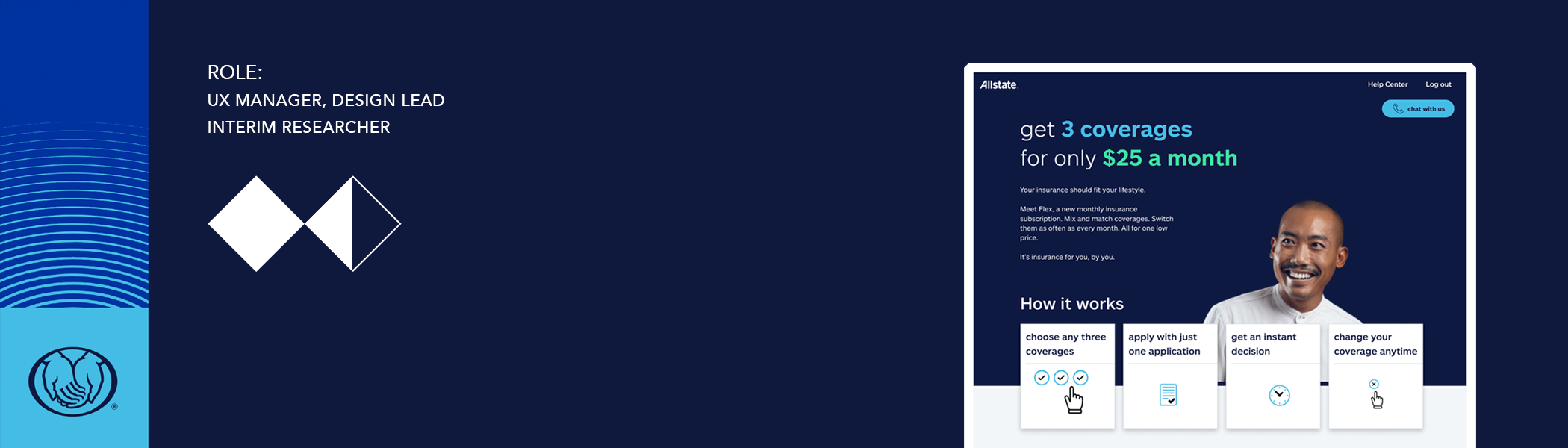
As Experience Lead, I oversaw a multi-disciplinary team of UX and UI designers, Researchers, and Content Designers while serving as interim researcher to drive strategic research initiatives. I interfaced closely with business partners to lead the overall strategic vision while providing more specific guidance and feedback to the design team to oversee the creation of the first membership-based insurance product in the U.S. market.
My role involved close collaboration with Product, Marketing, and Behavioral Science leaders on market positioning, branding, and messaging while translating market research into foundational personas and conducting iterative user research to validate and evolve the product through rapid, hypothesis-driven cycles.
The VP of Life Insurance decided to bring a brand new product to the market - a membership-based platform. It was envisioned as a flexible subscription platform offering micro-slices of protection (mini coverages) at a low monthly cost. Hence, the project name Flex.
Flex Insurance aimed to revolutionize the insurance industry by offering consumers a unique subscription model that prioritized flexibility and affordability. The concept allowed customers to easily discover, purchase, and manage their insurance coverages, allowing them to swap coverages at any time. The project's primary objective was to disrupt traditional insurance models and create a seamless, user-friendly experience for customers..

PROJECT
OVERVIEW
PROBLEM
Following extensive market research that validated initial appetite for the concept, the launch strategy for Flex Insurance was focused on delivering a proof of concept with minimal initial investment. The metrics for success were not fully defined, but the target was to achieve a conversion rate three times higher than that of a single insurance product in the existing portfolio.
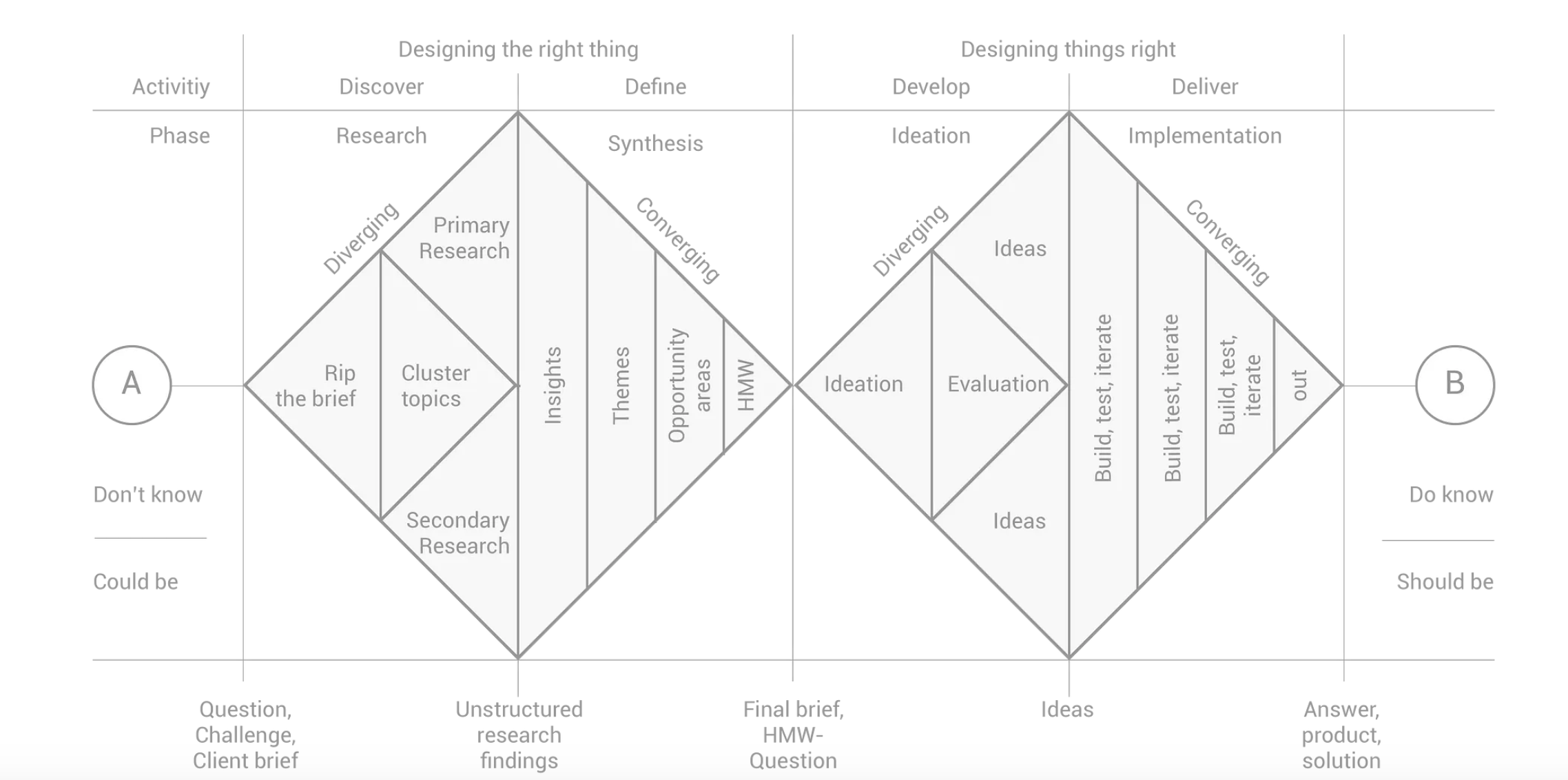
The goal was to create the product from the ground up while employing a start-up mentality - working in lean, rapid iterations and forming hypotheses that we validated through continuous user feedback. We were operating on a tight budget of $10M for MVP Design and Development and had four months to do it. However, before starting development, we needed to answer one critical research question: "Are we building the right thing?"
Are we building the right thing?
Following the Double Diamond model, we embarked on a discovery phase to determine who our customer/user was to answer a set of questions:
Will they be interested in this type of product? After all, there is no current precedent for offering micro-slices of protection.
What type of insurance should we offer?
How many mini-coverages?
At what price?
What does flexibility mean in practical terms?
Were were facing several challenges:
PRODUCT
How might we successfully launch
first-ever in the market offering?
Membership-based insurance currently does not exist in the U.S. Outside of America, HSBC Global Bank in the UK offers a similar product. We needed to learn more to understand the market.
OPERATIONS
How might we operate like a start-up within
an established organization?
The product and business leaders came from Google and Amazon and expected a quick turnaround and a start-up mentality, which can be challenging within an established corporation like Allstate.
LEADERSHIP
How might we execute on a shoestring budget with a bare-bones team?
At the beginning of the project, the team was missing two vital roles: UI Designer and UX researcher. The project had a very limited budget—all of the above required creative problem-solving.
Solution
To establish strategic direction, I collaborated with our business partners to establish a plan for discovery research, consisting of secondary and primary research and a series of workshops for key stakeholders and UX team.
Solution
I facilitated effective communication between UX and Product leadership to streamline existing UX processes, use a leaner approach, and revise expectations to increase speed-to-market while preserving the user-centered approach and key stages of the double-diamond model.
Solution
I instituted daily stand-ups for the UX team and artifact reviews 2x a week for input and decisions from key stakeholders. I built a business case and obtained funding for additional roles from the Product leadership.
OUR VISION
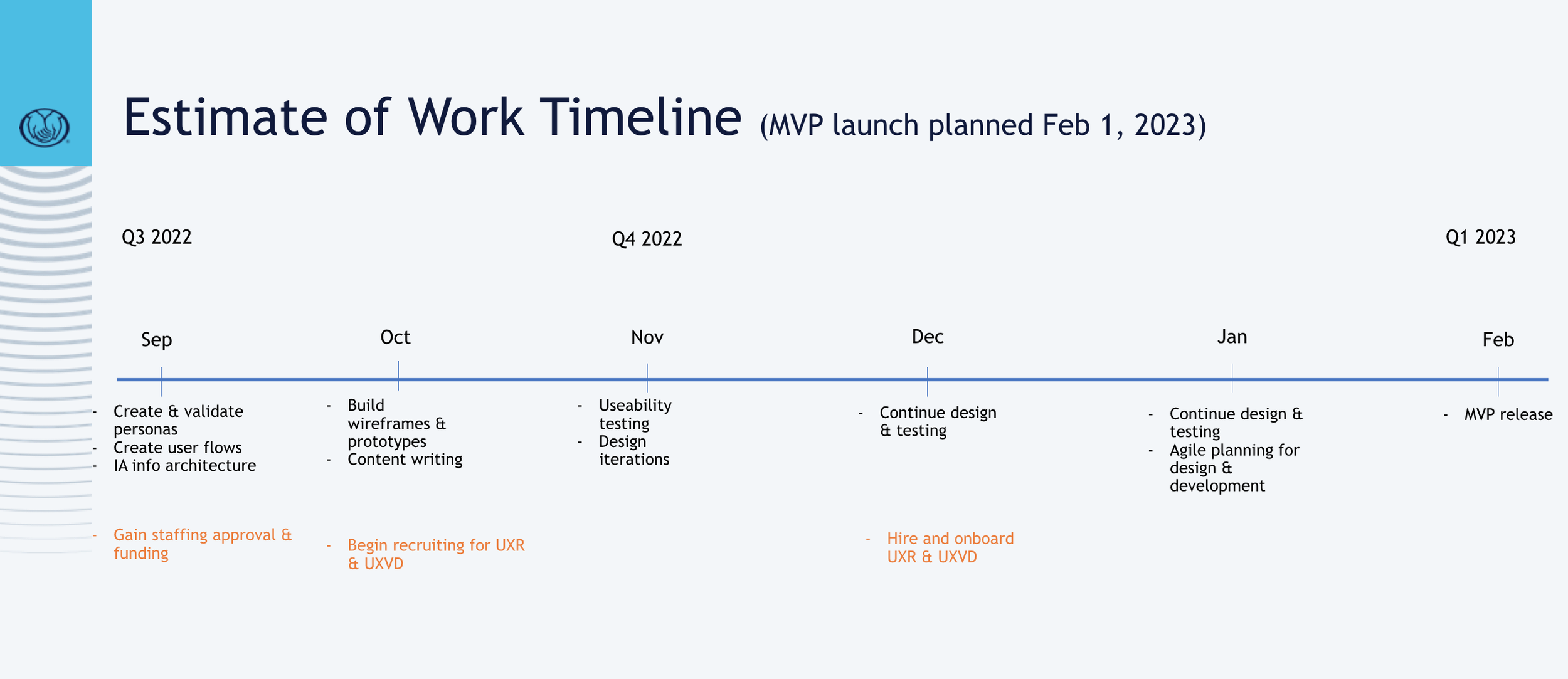
The vision was to disrupt and transform how consumers discover, purchase, and engage with insurance. The goal was to build and launch MVP within 4 months.
Discovery Phase
Following extensive market research that validated initial product appetite, I led the foundational research strategy as interim researcher to rapidly establish our target user base. I developed foundational personas based on market study findings and created journey maps that identified critical touchpoints for the membership experience.
Operating in true start-up mode, we wore many hats to accelerate decision-making and worked as "one team" with business partners. I leveraged the agile design framework, instituting 3x-a-week stand-ups and bi-weekly stakeholder sessions to maintain alignment within our $10M budget constraints.
Rather than extensive upfront research, we embraced a lean research methodology - gathering just enough insights to move forward confidently while planning for iterative validation throughout the design process.
What we did
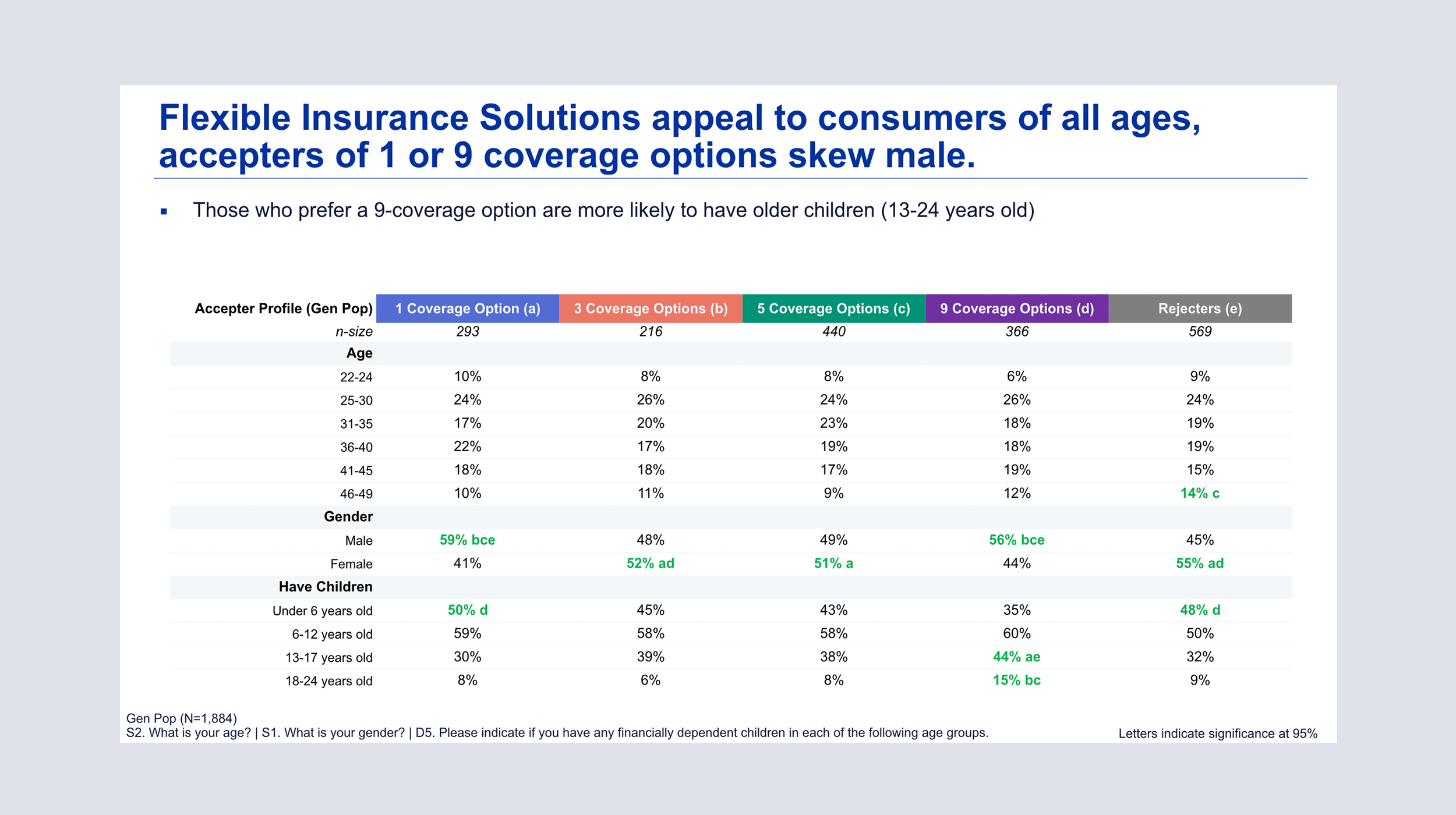
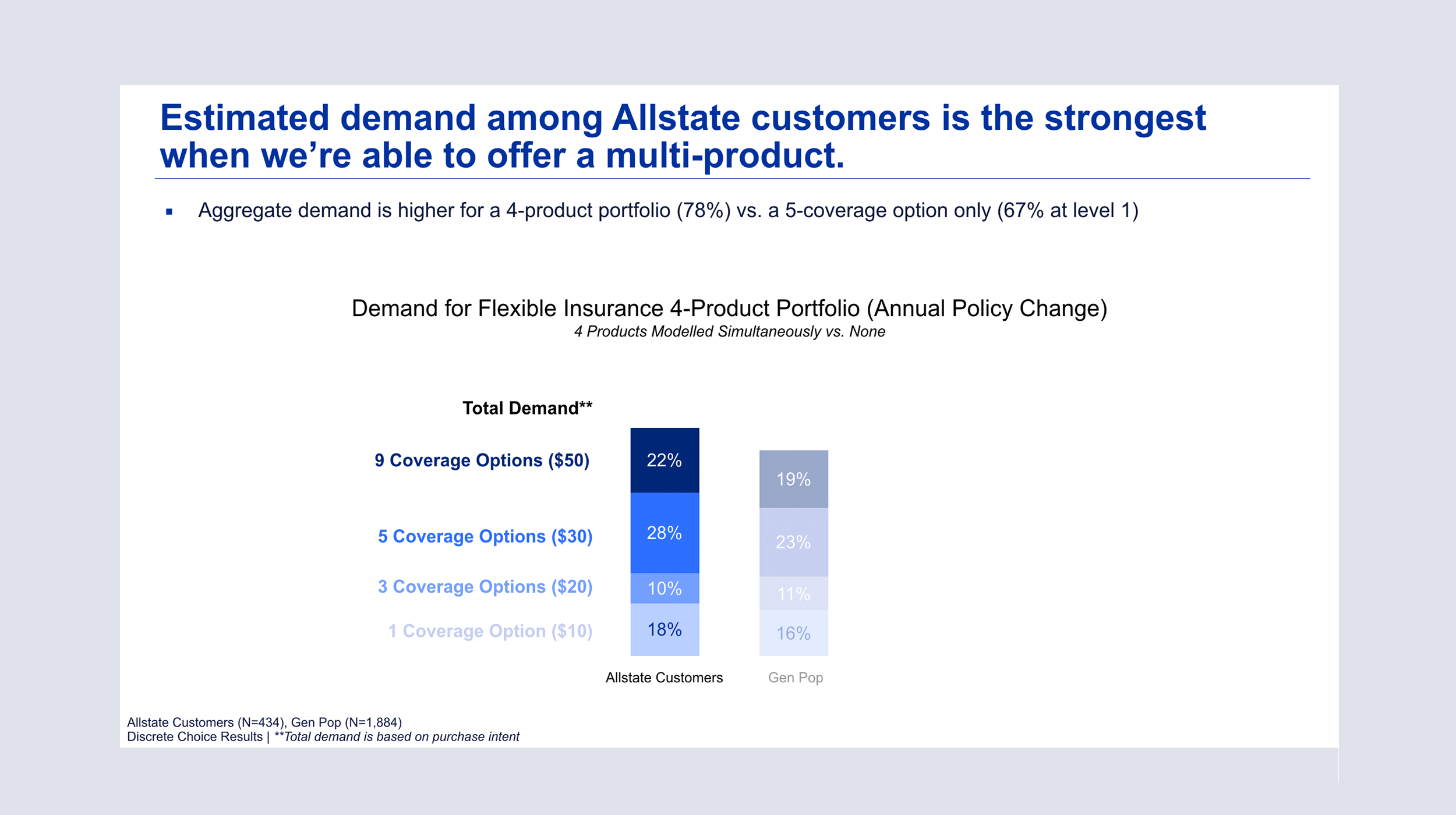
Conducted extensive market study with 2,300 participants to determine target market and pricing.
Performed competitive analysis to evaluate direct and indirect competitors.
Consumed and synthesized internal and external secondary research.
Conducted customer interviews to build a user persona.
Created user journey, experience flow, and service blueprint.
What we learned
None of the U.S. competitors offered this type of insurance product.
The general population and Allstate customers had an appetite for Flex.
Three categories were most appealing: Life Insurance, Financial Protection, and Supplemental Health.
The most attractive price was $25 per month.
For MVP, we would offer a choice of 3 coverages out of 7 options.
The first set of artifacts
In the spirit of quickly building MVP, we created some initial artifacts. The team collaborated with our product partners and established an experience flow,
a user journey, and a high-level service blueprint.
User Journey
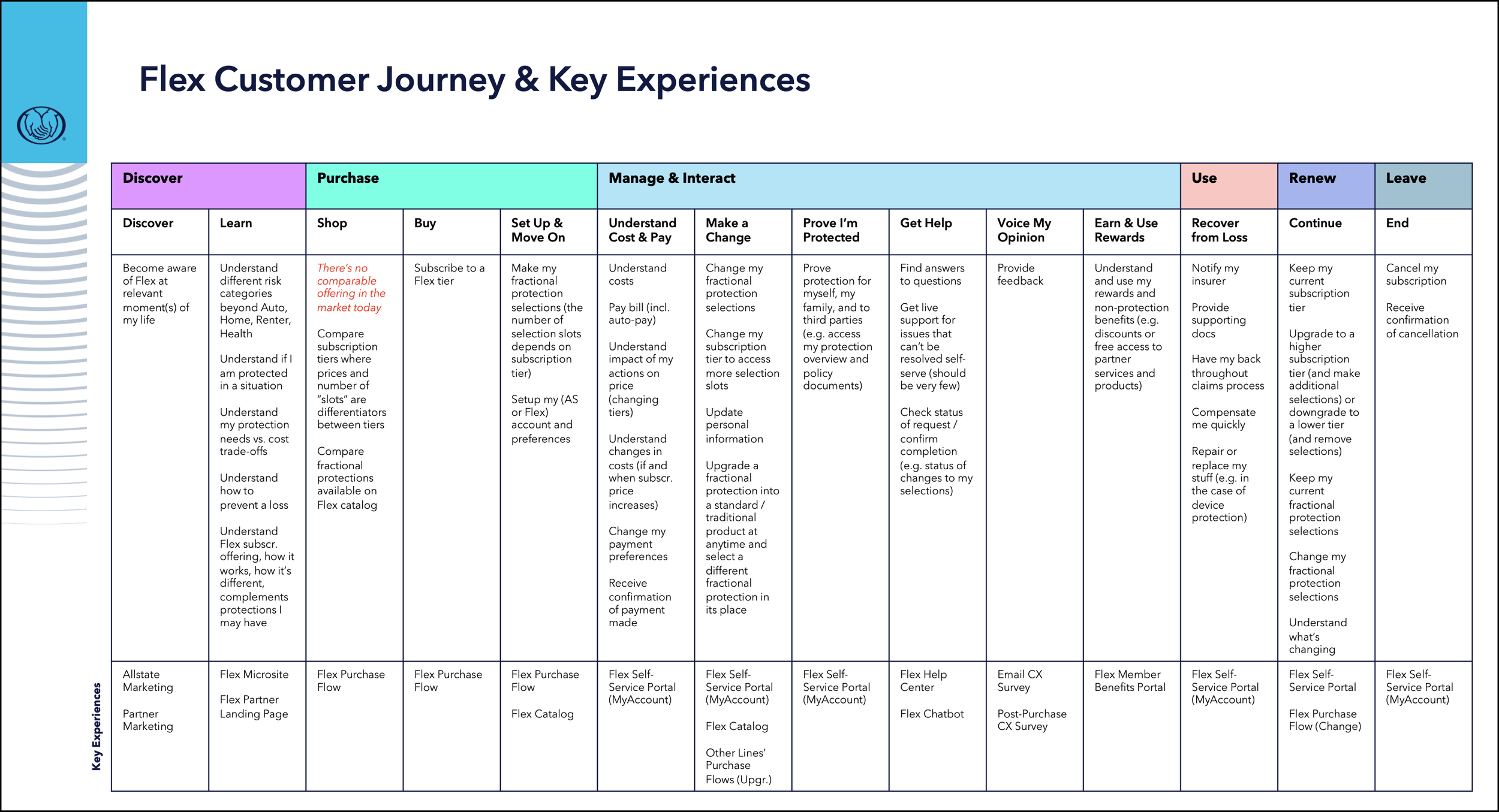
We based the user journey on the standard Allstate template
and modified it to our needs.
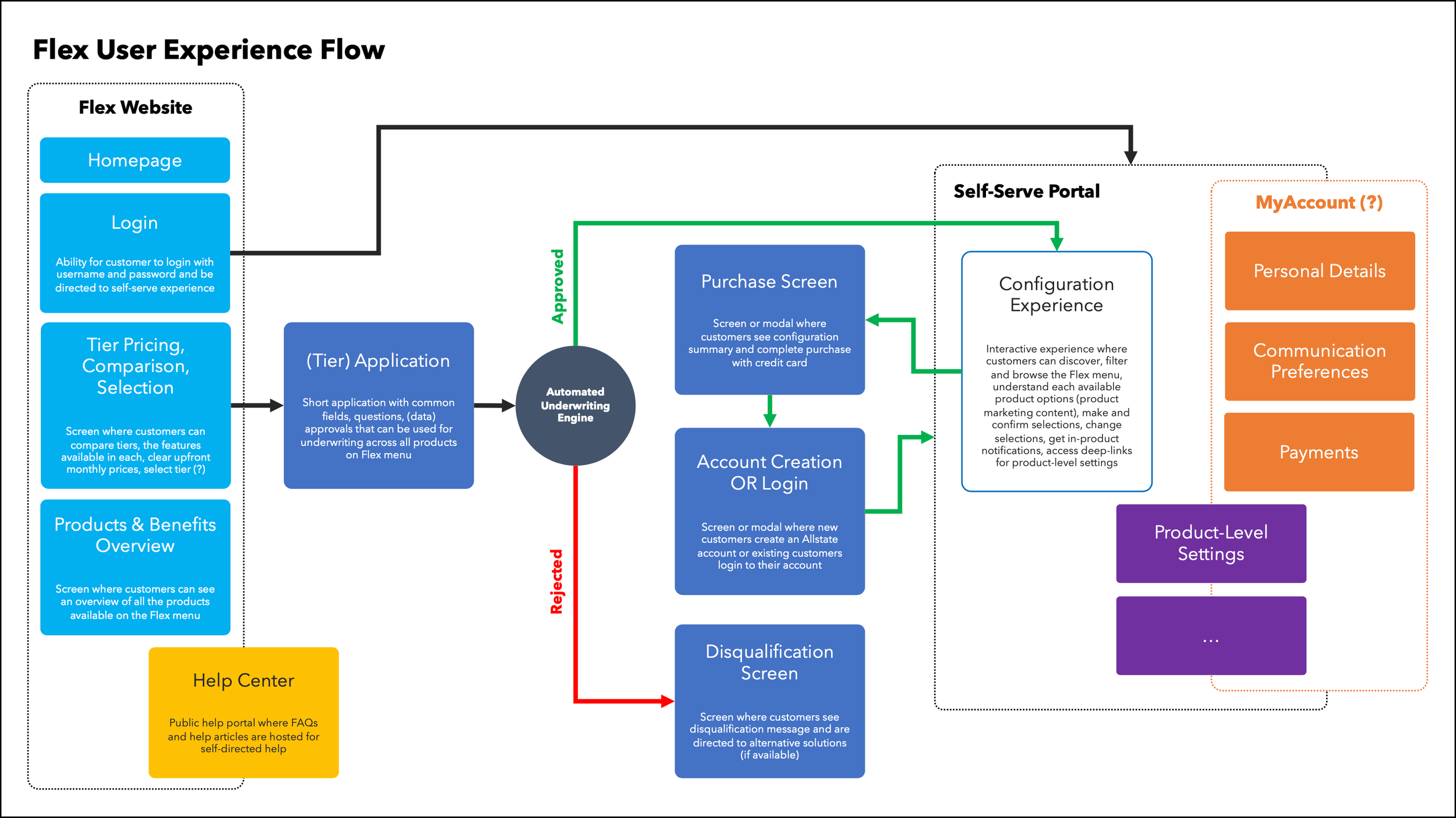
Experience Flow
We worked with the Product Owner to define the key points in the Flex experience.
Service Blueprint
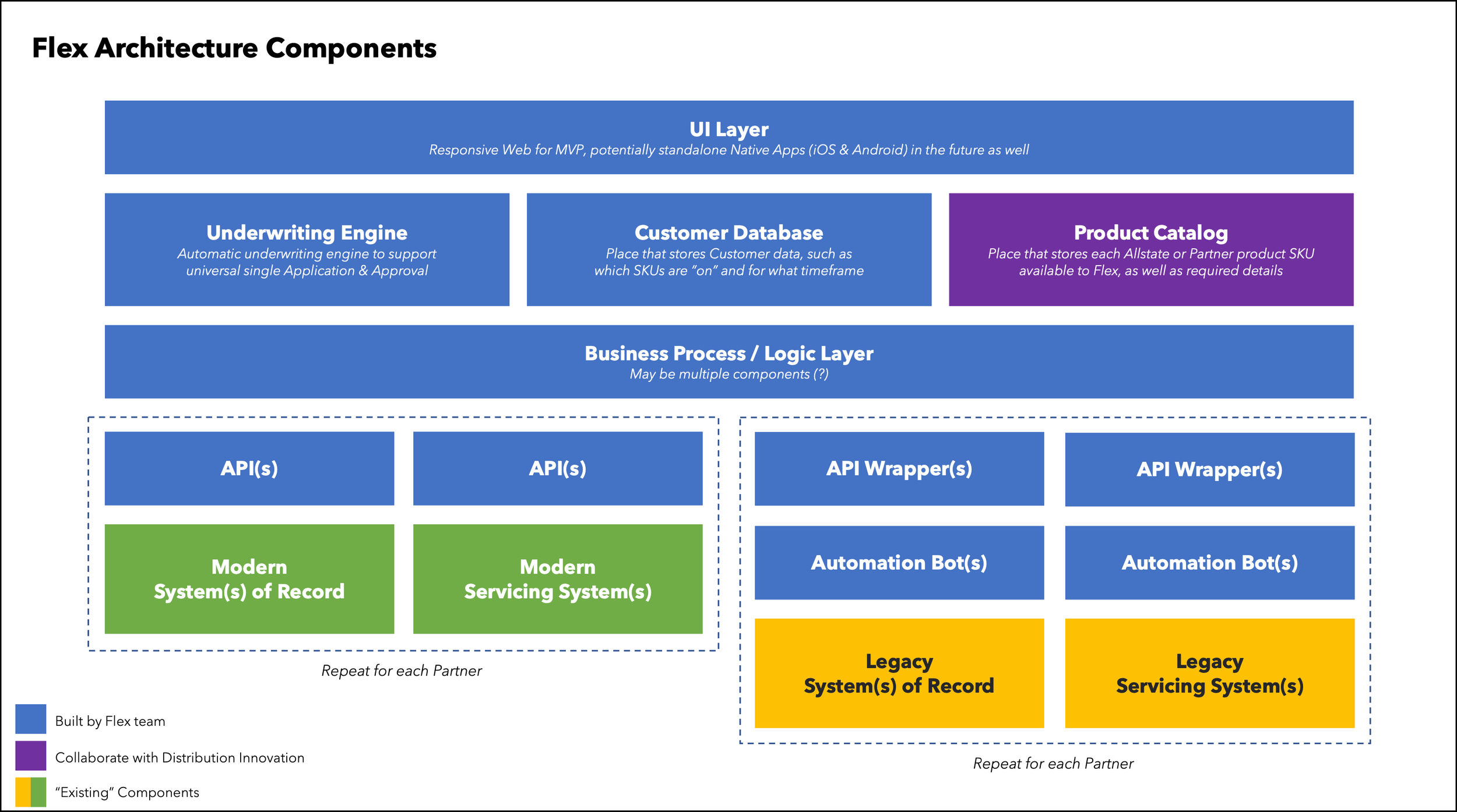
Even though we didn’t have a dedicated development team yet, we consulted two technical leads
to create a service blueprint outlining the data flow and services needed.
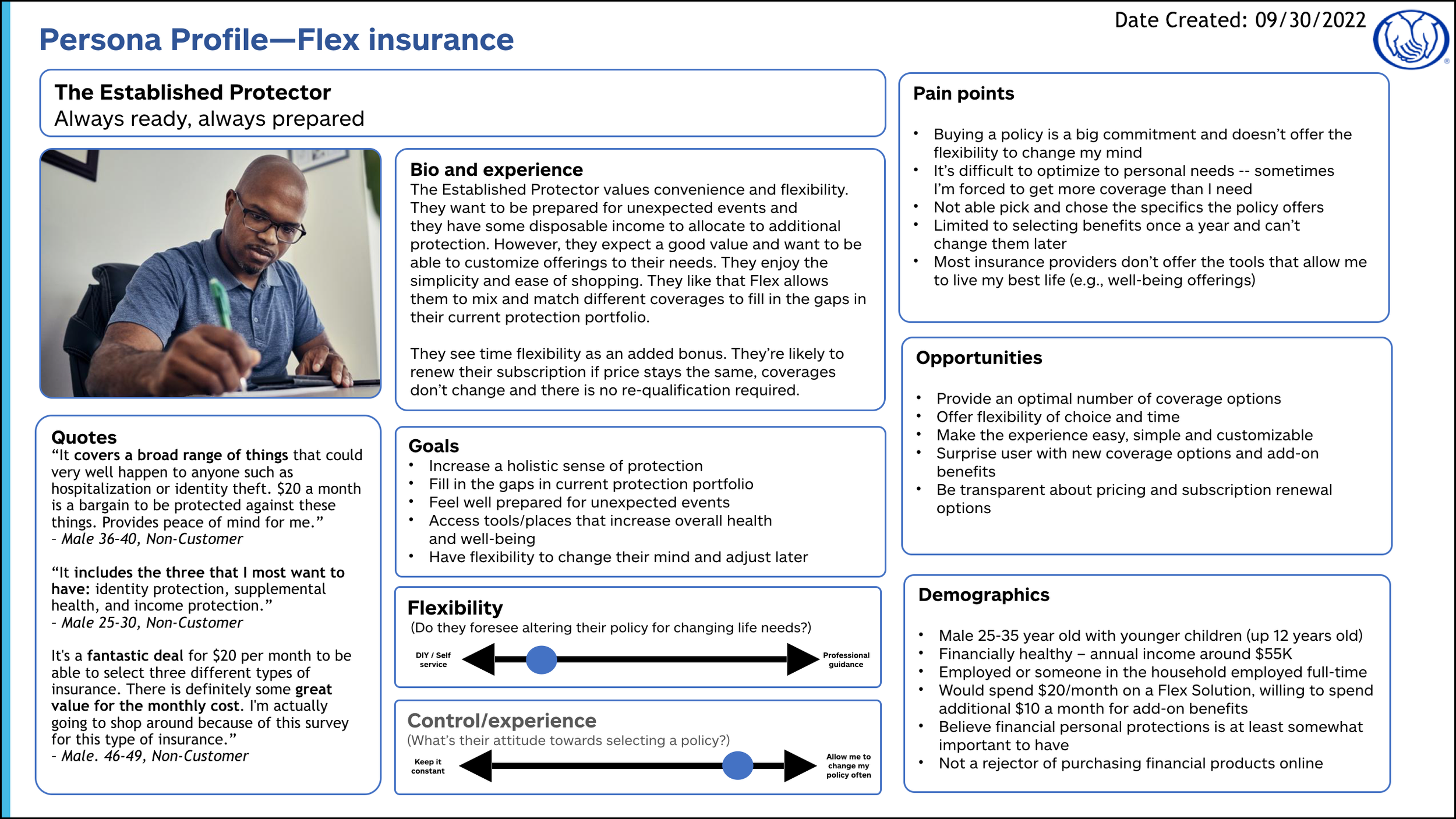
We created an assumptive persona based on market research and used the Zoom Go app to recruit and interview participants.
We learned that Flex appealed to customers with an annual income of at least $100K. They saw Flex as a supplement to their existing insurance portfolio. This shattered our assumption that lower-income customers ($35K or less) would be interested in micro-coverages.
The “Established Protector” persona was created.
Click here to view the persona
User Persona
Product Definition
Since we had a better understanding of the market and the user we moved on to defining the product.
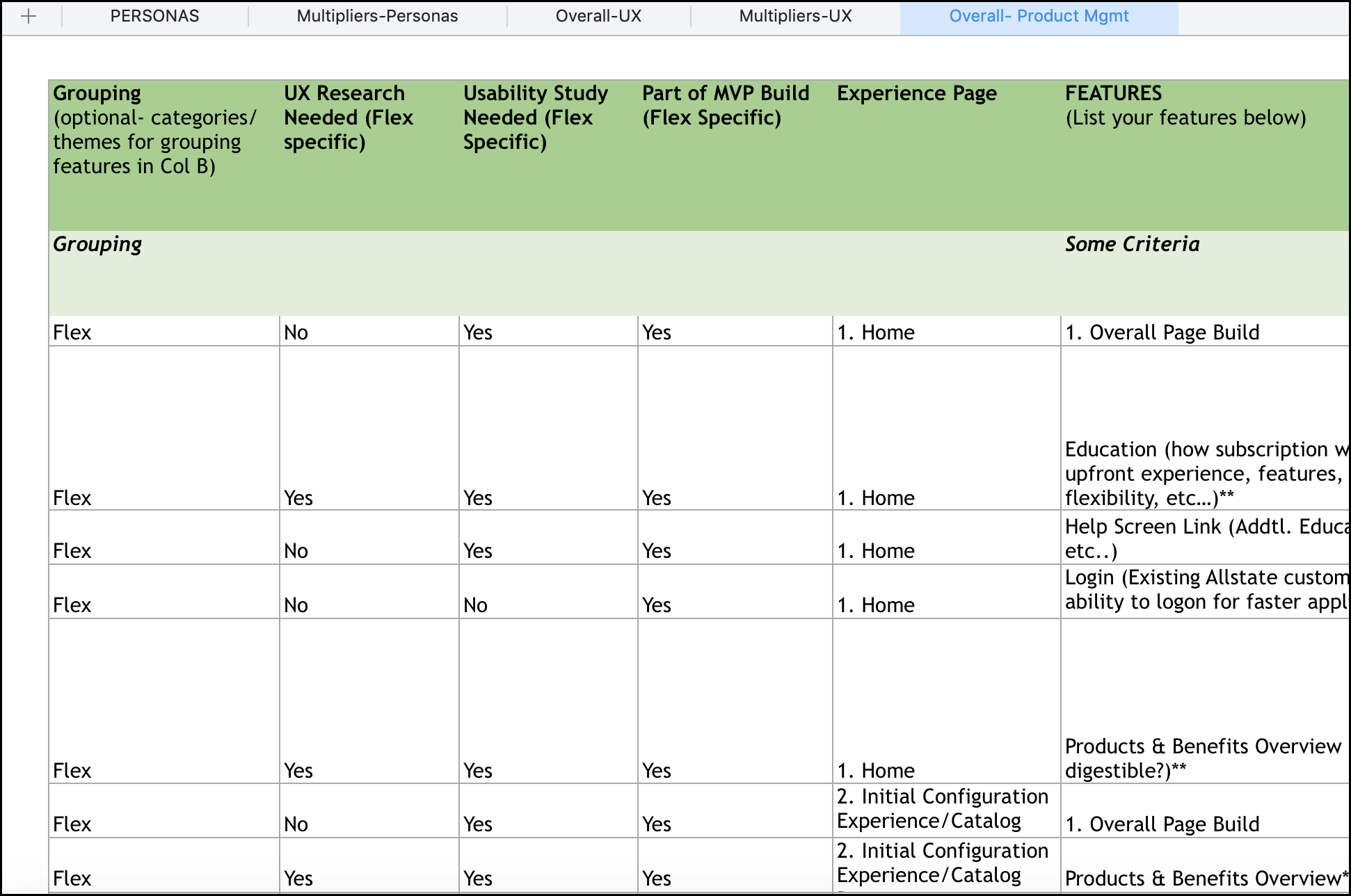
Feature Definition
During the two 2-hour sessions with the key stakeholders, we defined the MVP and some post-MVP features. In addition we outlined future research and testing needs. Results from this effort helped the Product Owner define business requirements for Flex.
View the feature list
LEADERSHIP & OPERATIONS
Resourcing & Recruitment:
Built a business case and procured $432K in funding directly from the Product Leadership, bypassing the hiring freeze within the UX Organization. View Business Case
Initially, I stepped into the role of researcher and later filled the UX Research gap with a borrowed resource from another team while searching for a full-time team member.
I utilized my internal network to recruit a UX Researcher. I collaborated with the UX Research Manager to transfer one of the contractors to my team.
Collaborated with business partners to assess and pick engineering vendors.
Design and Content Execution:
Implemented a dual track of work - one track for the critical screens requiring close collaboration with stakeholders: Homepage and Product page. The second track for the remainder of the experience flow.
I directed the team to reuse and modify screens from existing products where possible.
I paired a UX Designer and a Content Designer to work together to deliver designs and obtain legal approvals, each providing their expertise when required.
I worked closely with the Design System lead to create new, unique patterns for Flex while aligning with the Design System standards.
Product Refinment
Flex defied the traditional insurance mental model. Thus the homepage needed to clearly convey value proposition and benefits of Flex. And serve as a Landing Page due to a minimal marketing budget.
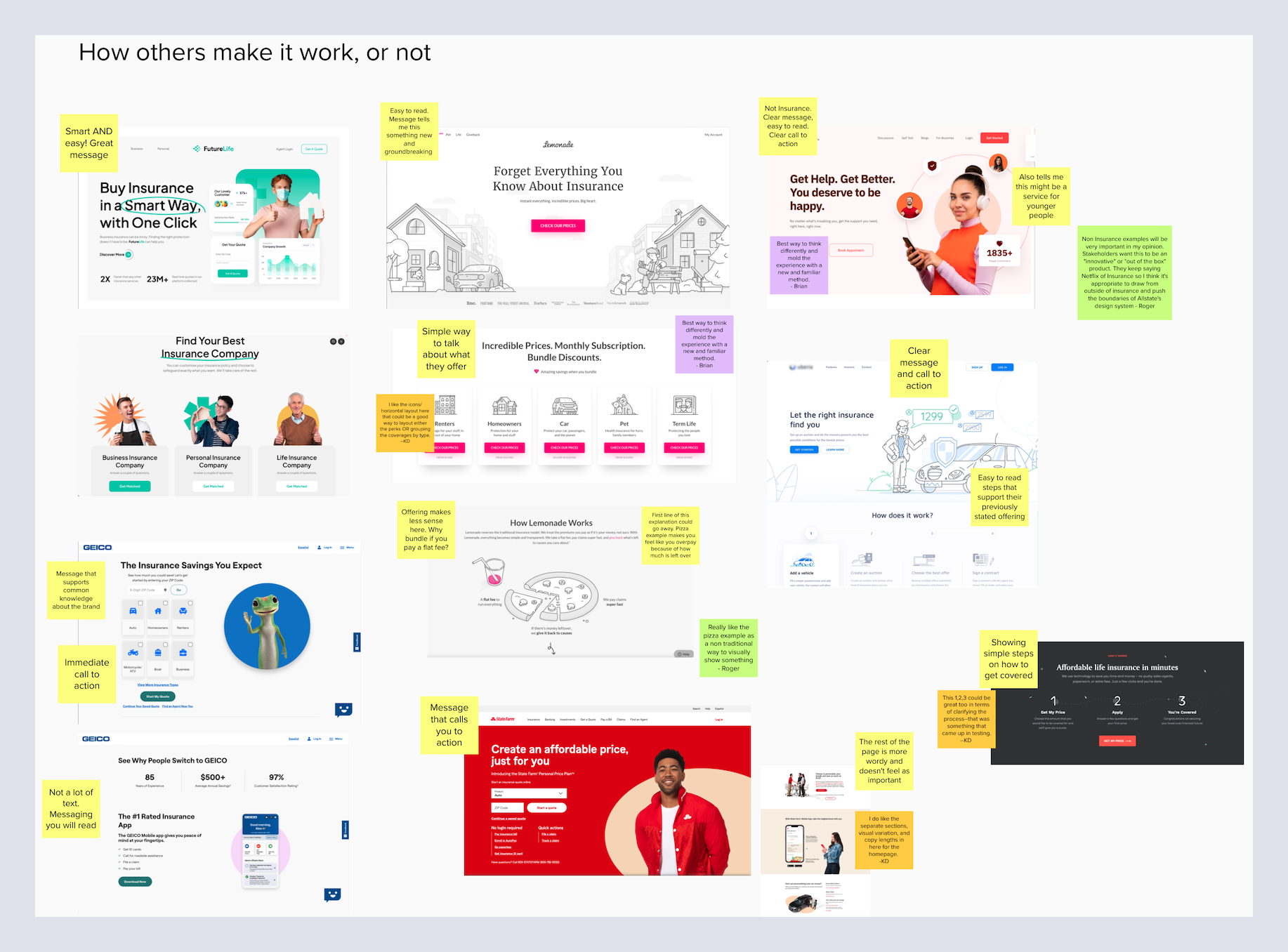
First task was to review how other companies, especially in Insurtech and Fintech present their products on the homepage.
Secondly we embarked on a series of sketching sessions to shape the homepage and product page
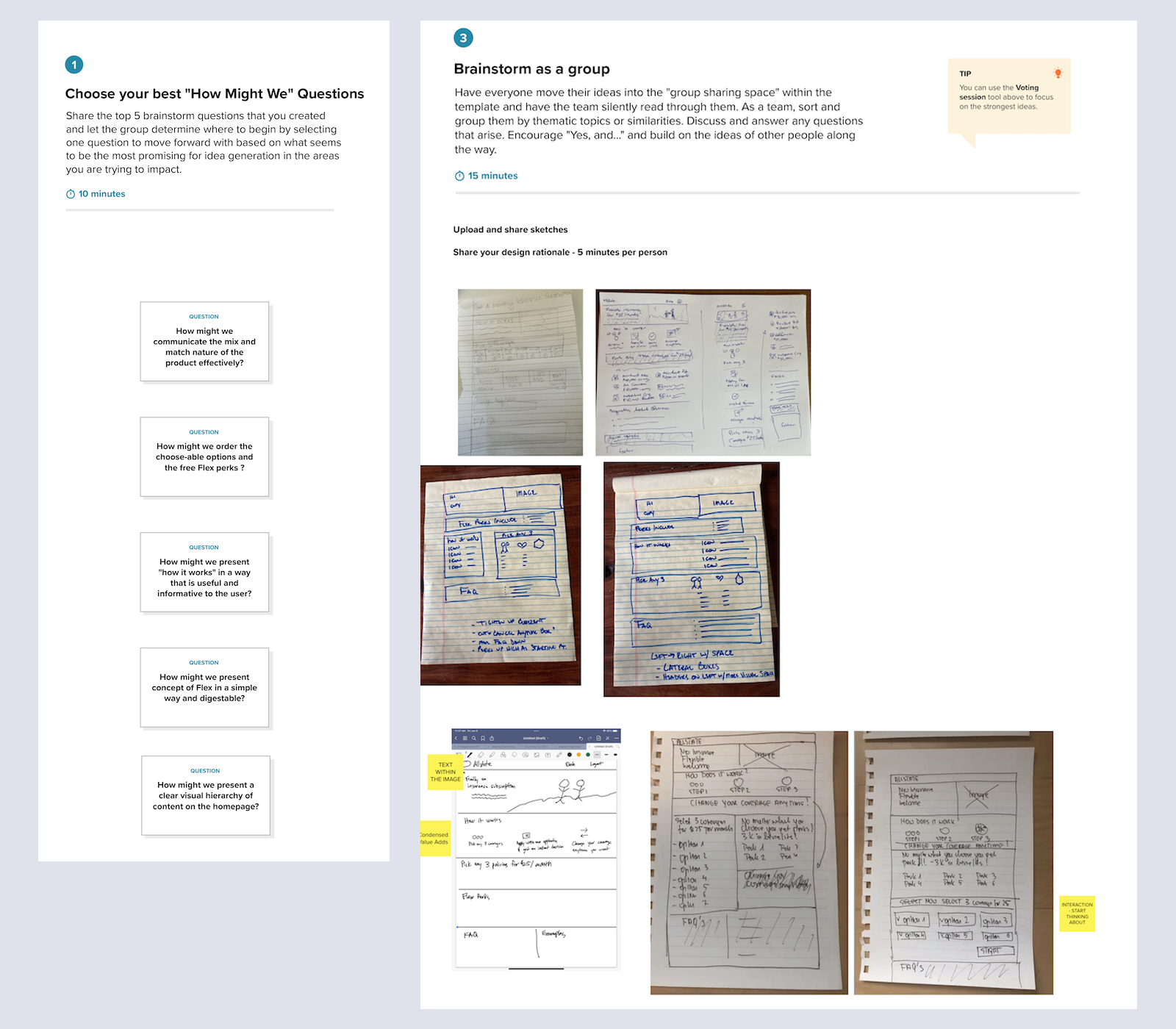
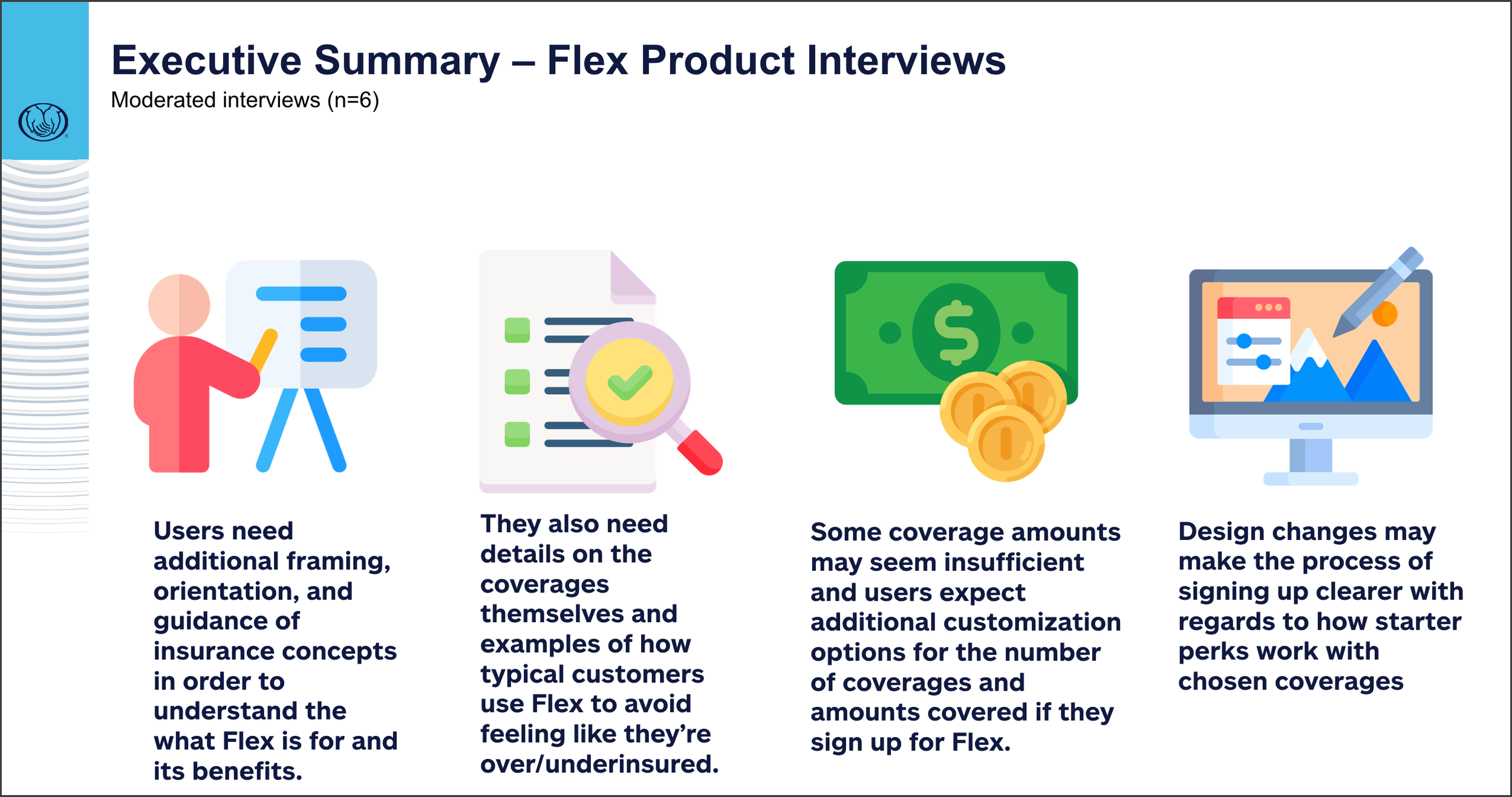
User interviews and a survey of over 100 participants revealed that:
Users needed additional framing and guidance of insurance concepts to understand what Flex was about.
Participants needed more details on coverages themselves.
Customers needed clarification on how Perks work in tandem with chosen coverages.
They wanted a better-organized coverage section with details and examples.
Having Perks presented first was easier to understand.
View research report
Value Proposition Workshops
More work was needed to position Flex as a viable solution and help us finalize the homepage design.
Consequently, I conducted a Value Proposition Workshop with Product, Marketing, and Behavioral Science stakeholders. Strategically, the decision was made to offer Flex membership as a cross-sale option during quoting for Home, Auto, and Condo.
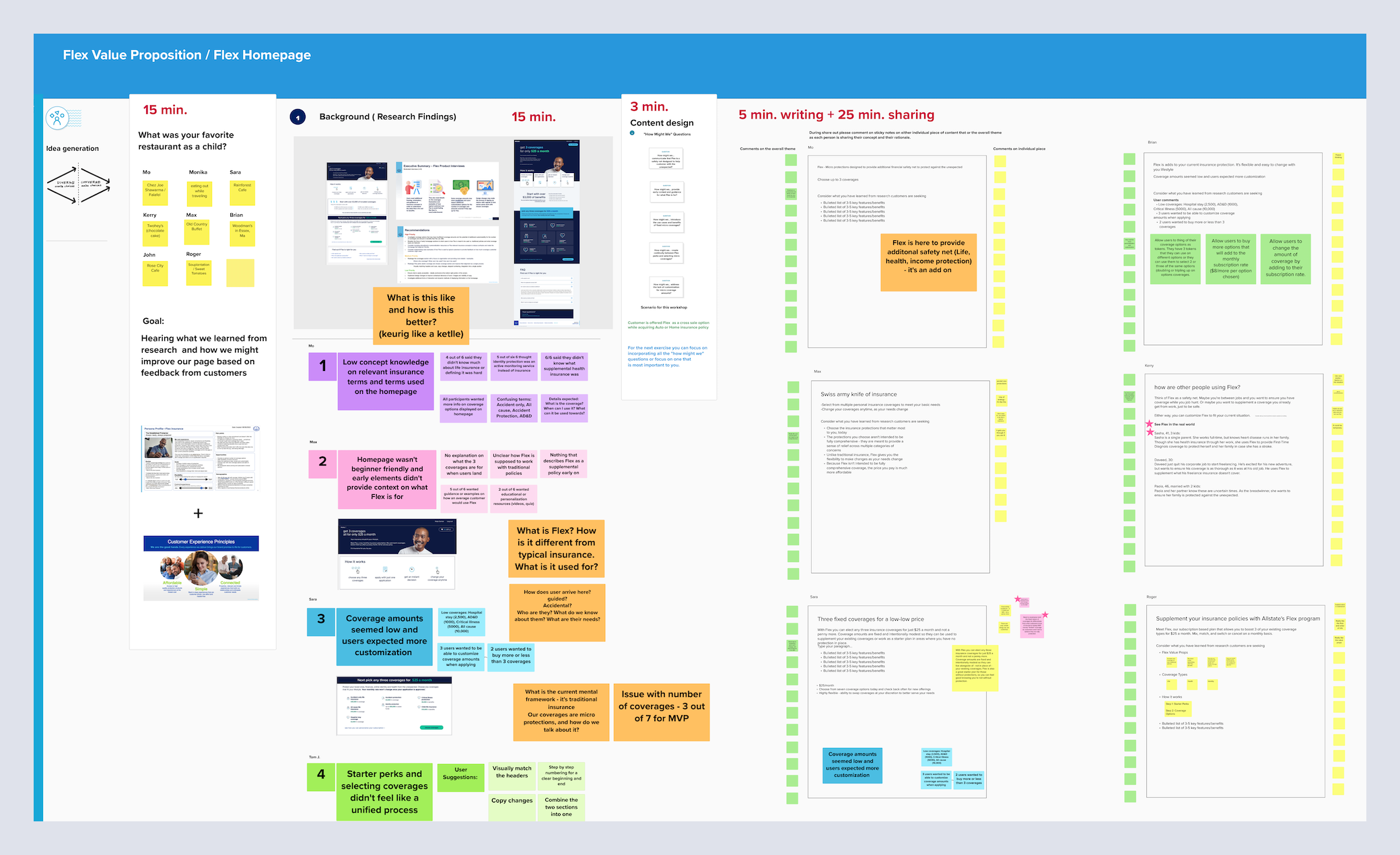
Homepage concepts
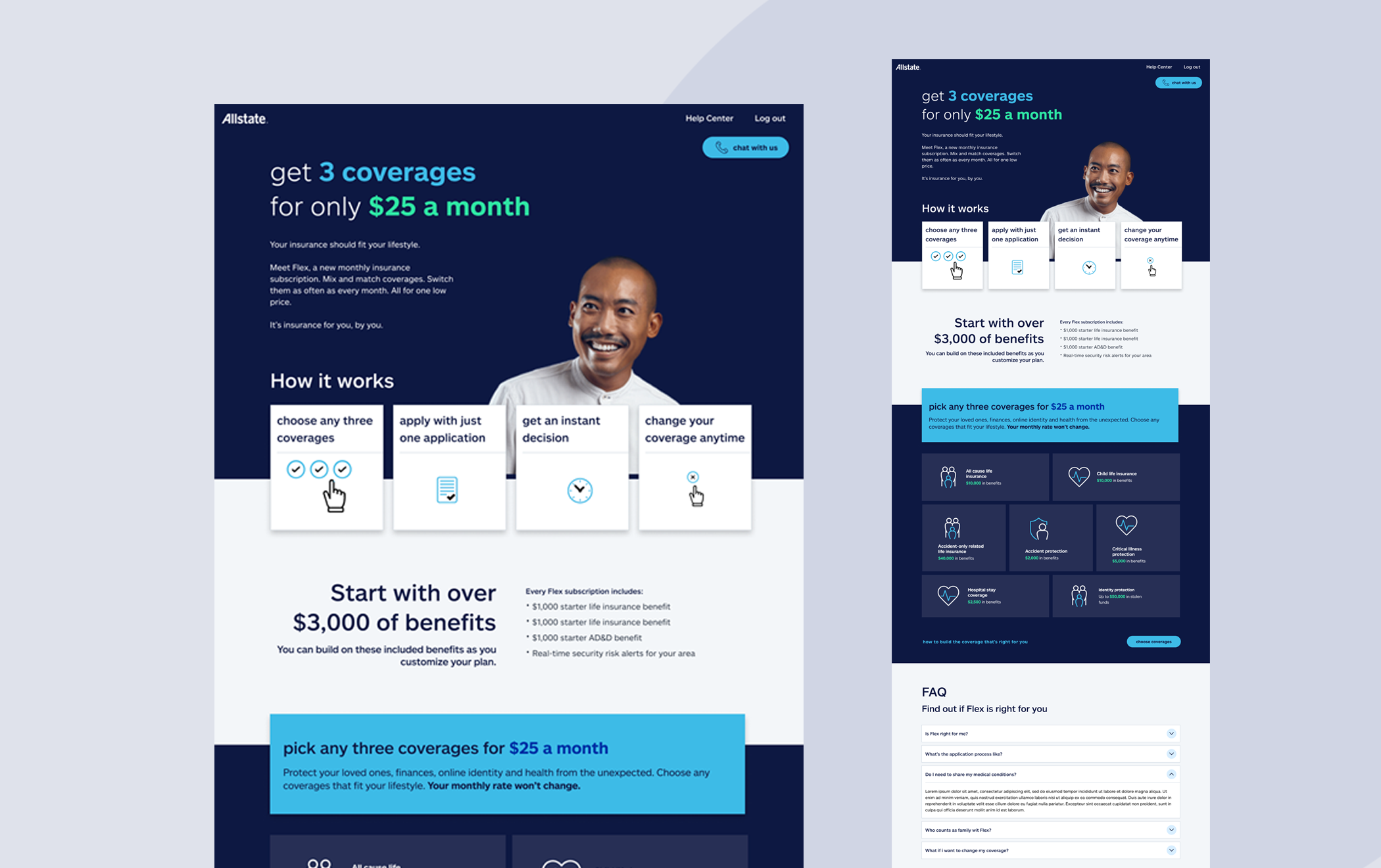
The homepage needed to perform a double duty of Landing Page and application homepage. The design needed to orient the user to how Flex is meant to be used versus traditional policies.
It needed to convey the product's key attributes and entice the user to engage without overwhelming them.
Also, Flex offered built-in benefits called Perks, in addition to mini coverage selection, which needed to be clear to the user.
View homepage visual comp
View homepage sketching session Mural board
Preparation for development
Proof of Concept for Product Leadership
Preparing deck with final designs and design context based on UX Research and ideation sessions.
Engineering Vendor Onboarding
The external engineering team couldn’t use
components from the Allstate Design SystemThey need to customize front-end code to match interactions and the Allstate brand.
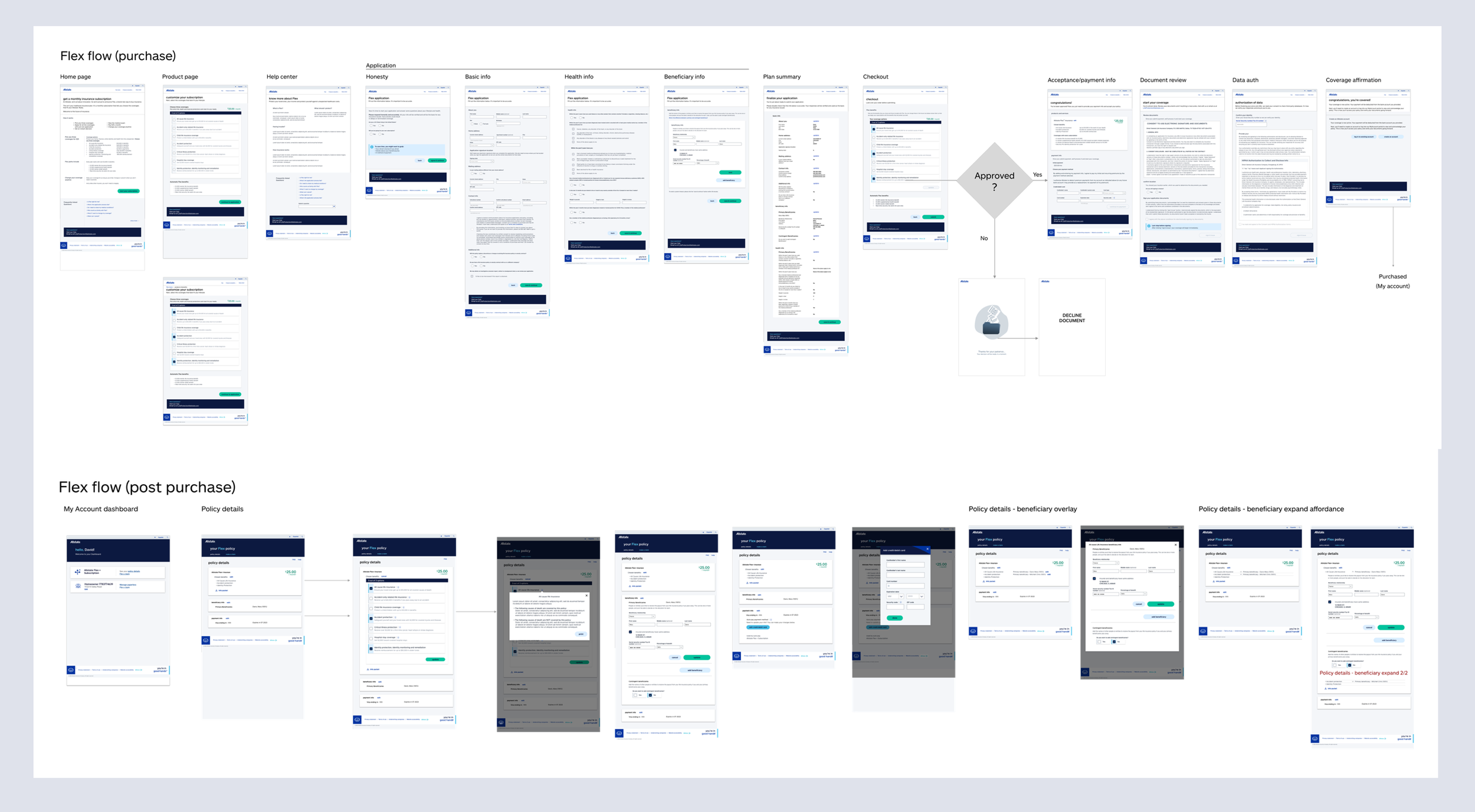
Development-ready experience screens
UX and Visual Design reviews
Content and legal approvals
Approvals with UX Leadership
Next Steps
Collaborate with engineering on design implementation
QA MVP for design accuracy
Design claims flow and post-MVP features
Establish UX metrics
Moving forward, the team remained committed to disrupting the insurance market and delivering enhanced value to customers through innovative solutions like Flex Insurance. After the hand-off to the development vendor, the focus shifted to the following tasks: